

Advancing PEM Electrolyzer Durability Through Integrated Degradation Modeling
We are happy to share that an article by AAU and POLITO, titled “Integrated multi-mechanism degradation modeling of a catalyst-coated membrane in a PEM electrolysis cell operating under renewable-powered conditions”, has been published in Computers & Chemical Engineering.
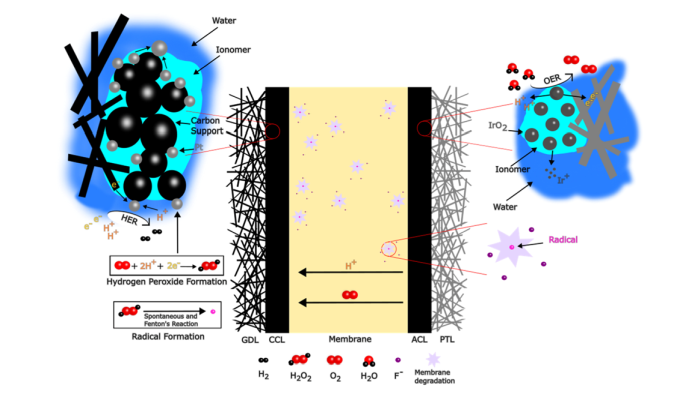
The study explores the long-term performance of proton exchange membrane (PEM) electrolysis, a key technology for producing green hydrogen that can be used to manufacture sustainable electro-fuels for aviation and maritime transport. The researchers developed an integrated model that captures several critical degradation mechanisms within the catalyst-coated membrane, including membrane thinning, iridium dissolution in the anode electrode, and platinum agglomeration in the cathode electrode.
The findings show that membrane thinning is the primary factor limiting PEM electrolyzer lifetime, significantly affecting efficiency and power consumption over extended operation. The study also demonstrates that operating conditions have a substantial impact on durability. Higher current densities accelerate degradation and reduce system lifetime, while lower operating temperatures, although slightly reducing initial efficiency, can improve long-term performance by slowing degradation.
Additionally, the research evaluates the effects of pressure and idle operation on cell degradation and identifies operating conditions that offer the most favourable balance between efficiency and durability.
This work provides valuable insights for the design and operation of PEM electrolyzers powered by renewable energy, supporting the development of more reliable and cost-effective green hydrogen production technologies.
Congratulations to all authors on this important contribution to the field of sustainable energy systems!