

We are pleased to share a new ELECTROLIFE publication by POLITO in the Journal of Power Sources: “2D multiphysics model for proton conductor ceramic technology investigating the effects of temperature, composition of reactants and electrolyte material”.
This work presents a comprehensive 2D multiphysics model of a protonic ceramic electrolysis cell (PCEC), an emerging technology with strong potential for efficient hydrogen production. The model combines thermal, fluid-dynamic and electrochemical phenomena to investigate how operating conditions, gas composition and electrolyte materials influence cell performance.
A key focus of the study was understanding electronic leakage and its impact on transport number and faradaic efficiency. The results show that higher operating temperatures can improve electrochemical performance by lowering resistances, but may also increase electronic leakage, reducing the overall efficiency of hydrogen production.
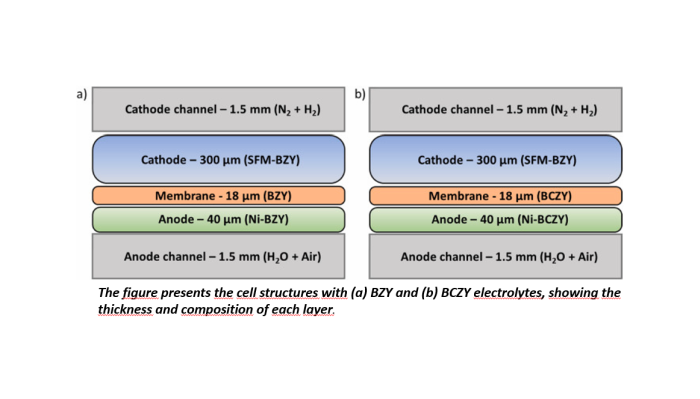
The research highlights the importance of optimizing operating conditions and minimizing electronic leakage to maximize PCEC performance. It also compares state-of-the-art BZY electrolytes with the newer BCZY material, demonstrating opportunities to improve proton transport and faradaic efficiency through advanced material design.
These findings provide valuable insights into the role of operating conditions, electronic leakage and electrolyte materials in PCEC performance, contributing to the development of more efficient hydrogen production technologies.
Congratulations to our partner POLITO on this achievement!