
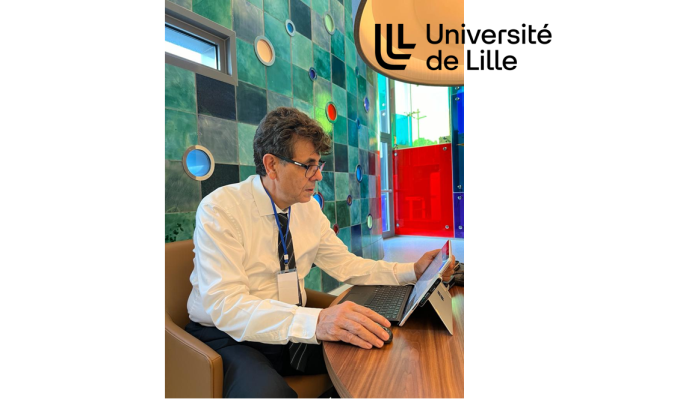
I’m full Professor in automatic control at Graduate School of Engineering Polytech Lille in France (ULille), where I have been Director of the Research for 15 years. I’m in charge of research team at the CRIStAL laboratory of the National Center for Scientific Research (CRIStAL, CNRS) in Lille, where my research activities concern Integrated Design for Supervision of System Engineering based on CNN Bond Graph theory mixing AI and physical knowledge dynamic models. Concretely, this integrated problem requires in the first phase to detect and isolate the faults before failure (progressive faults and cataleptic faults) then in a second step, to predict (anticipate failures) and finally, in a third step, to estimate the remaining useful life or manage operation in degraded mode. In the ELECTROLIFE project we are involved in several work packages but mainly in WP3 (Degradation modelling and lifetime prediction). Simply put, our goal is to develop algorithms in the form of a digital twin platform to monitor state of the health of the electrolyzer system in real time and make control decisions to improve the lifespan of electrolyser using different technologies.
What was your original motivation to become a researcher?
I have a background in engineering and initially worked in the oil and gas industry. My initial motivation for pursuing research was to move beyond operational and technological aspects and focus on innovation and, above all, the abstraction of concepts. I therefore decided to pursue a doctoral dissertation in the field of control systems to minimize pollution levels at the outlet of gas treatment plants. Research today gives me the freedom to turn theoretical ideas into reality, but also to share and continually improve knowledge. The greatest virtue of being a researcher is this constant connection with young people through my interactions with graduate and Ph.D students and the exchange with the world through meetings with researchers from around the globe. Research teaches us humility and tolerance.
What is your (main) research area today?
I am working on designing digital twins (replica of real process) for the entire green hydrogen production chain, from renewable energy sources (solar and wind) to Hydrogen transportation. What is the technological and scientific value of this research? Hydrogen production facilities are expensive, and conducting tests is dangerous due to the flammable nature of this chemical. It would therefore be beneficial to create digital replicas on which we can perform optimization tests before moving to industrial-scale production. The scientific challenge is to ensure high accuracy in these digital twins; from a fundamental perspective, we use hybrid modeling and monitoring tools: This is a tool we are developing within my research team called BG CNN (Bond Graph Convolution Neural Network), which combines uncertain physical models with AI. Tests are already being conducted as part of the ELECTROLIFE project.
What are the main objectives of your team in ELECTROLIFE?
Electrolysers are expensive components; it is therefore essential to prevent any degradation and, consequently, to be able to detect such deterioration at a very early stage and predict its progression. Our objective within the ELECTROLIFE project is precisely to monitor (i.e. to detect and isolate these faults) in real time, using Multiphysics modelling and Prognosis and Health Management (PHM) prognosis algorithms. The technological challenge of this task lies in the fact that electrolysers are poorly instrumented. Our contribution to this task is precisely to overcome these difficulties by using innovative scientific tools based on complex physical models coupled with AI algorithms to minimize the amount of data required during the training phase and, above all, to improve the interpretability (explainability) of the generated alarms.
What expertise and facilities does your team have to meet those objectives?
The overarching theme that characterizes my research group is to address, simultaneously and coherently, the various aspects of designing sustainable systems, namely the modelling, diagnosis and prognosis of energy systems, and the computerisation of these procedures. To achieve these objectives, from an academic aspect, we are developing theoretical tools based on a graphical tool known as the LFT CNN bond graph, for both the physical modelling of energy processes and robust monitoring AI based and prediction with respect to parametric uncertainties. Our team’s expertise https://www.cristal.univ-lille.fr/equipes/persi/ has capitalized on the research findings in this field through recognized publications and European and industrial projects, and has validated them through applications on a small-scale, multi-source platform housed at the laboratory.
Which aspects of your research at ELECTROLIFE do you find the most innovative and what unique opportunities offer ELECTROLIFE to you and your organisation?
Combining multi-scale experimental testing with advanced multiphysics simulations allows researchers to model and explain how complex degradation mechanisms occurring in green hydrogen production process overlap in real-time. This underpins predictive State-of-Health (SoH) and remaining useful life (RUL) diagnostic tools. Using advanced theory based on hybrid approach namely Physics Informed Neural Networks (PINNs) applied to different types of electrolysers is one of the most innovative aspects in our research. The project has provided us with a number of opportunities, which we can summarize as follows: (i) Cross-Disciplinary Ecosystem connecting 17 industrial and academic partners across 9 European countries, bridging electrochemistry, materials science, advanced physics, and data analytics., (ii) Sharing Infrastructure & Diagnostic Tools via Direct access to specialized test benches, characterization facilities, and advanced modeling frameworks across top European institutions and finally (iii) Standard-Setting & Data Integrity Establishing standards and ensuring data integrity by implementing standardised testing protocols and operational benchmarks.
How do you see the future use and impact of the ELECTROLIFE results?
The results obtained as part of the project—which have already been validated on a set of semi-industrial and laboratory platforms provided by the partners—will be used by industry to scale up to an industrial level for the design of electrolyzers. Furthermore, the project has enabled us to establish collaborations among our partners, both for joint publications and for participation in other projects.